Music > Barcelona
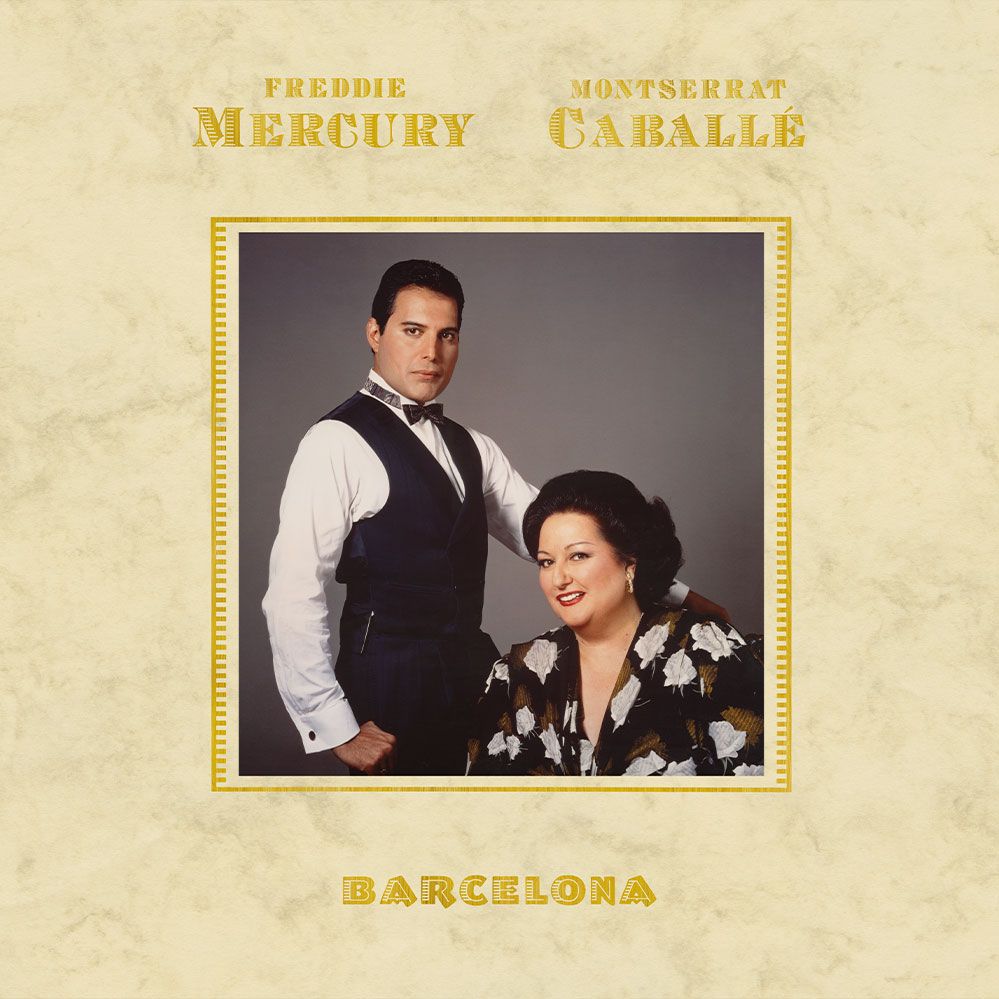
‘Barcelona’ was one of Freddie’s most ambitious, challenging and courageous undertakings. He regarded it as one of the most rewarding projects of his career, and among the projects of which he was most proud. Working with Montserrat Caballé was the realisation of a dream he never really expected to come to fruition.
In July 1986, during an interview for the Spanish Arts TV programme Informe Semanal, Freddie discussed his passion for opera, and in particular his love of Montserrat Caballé’s voice. The main reason for his visit to Barcelona, he explained, was because he wanted to meet the diva. The message did not go unheard, and word got back to Montserrat. Manager Jim Beach contacted Queen’s promoter in Spain, Pino Sagliocco, to set up a meeting, and Freddie’s dream became reality nine months later. He finally met Montserrat at the Ritz Hotel in Barcelona on March 24, 1987 — the birth of perhaps the most extraordinary collaboration in modern recording history.
Freddie flew into Barcelona with Jim Beach, composer/arranger Mike Moran, and personal assistant Peter Freestone, taking with him a tape of a song he had written specially for the occasion.
Peter Freestone: “They sat down... for about two or three minutes there was a silence. And then Freddie turned to Montserrat and said, ‘Well, I’ve got a song for you. Shall I play it?’ And that was it, that broke the ice.” The track was Exercises In Free Love.
‘Wonderful!’, Montserrat enthused. ‘I shall give it a world premiere in three days time at Covent Garden’.
Montserrat Caballé: “I walked into the room. Freddie’s hands were so cold, and I was very cold too. So I thought, he is nervous too, that is good, because when people are nervous that means they are expecting something from the other one. So, later we stand up from the table and went to the corner of the room to the piano, and he was playing, and I was beginning to see his ideas. We could have gone on for hours and hours and hours. When we finished, we look at each other, and I knew it; that he has conquered me!”
The pair spent the afternoon singing together, with Mike Moran at the piano, in the hotel’s garden room.
On March 29, Montserrat performed to a sold-out Covent Garden. Freddie attended and was, by all accounts, a quivering wreck. True to her word, as her final encore Montserrat surprised the audience by announcing a brand new piece, Exercises In Free Love, written for her by Freddie Mercury and Mike Moran. It evoked a standing ovation.
After the recital, Freddie, Mike, Montserrat and brother Carlos dined together at Freddie’s house. Montserrat asked Freddie if he would write a song about her home town, and he agreed. Discussions continued late into the night, with the group finally leaving at 5.00 a.m., and ideas worked would later form the basis of Barcelona and The Fallen Priest.
Mike Moran: “We played everything from Aretha Franklin to Jennifer Holliday, and Montserrat had a go at gospel music like a diva had never done before. She felt a wonderful sense of artistic freedom, which Freddie had brought into her life. She said that it was wonderful being with people for whom music was a very natural expression, rather than a ritualised process”.
David Richards: “Freddie set to work preparing the music at a frantic pace. Everything had to be absolutely perfect for the day when Montserrat would come into the studio and sing her parts. Freddie insisted on trying out every vocal line and phrase, not only his own parts, but those of Montserrat too, imitating her parts in a very high falsetto voice.
“I have never heard, before or since, a singer with such a vocal range as Freddie. He had to be in control of every note of the orchestral parts, examining and directing every violin part, every cello note.
“For weeks the three of us sat in the studio meticulously tracking the orchestral parts on instrument at a time, until finally it was perfect enough for Montserrat to sing her parts. The studio itself had to be polished, cleaned and made ready, and Freddie made Townhouse Studios redecorate the ladies toilets just in case she wanted to use them.
“We were nervous that day, but Montserrat sang the songs brilliantly and turned out to be the nicest and friendliest of people. It was obvious that she liked and admired Freddie very much. The whole vocal session was completed in a couple of hours.”
Barcelona (the song) was recorded in April 1987 and was first performed by Freddie and Montserrat at the Ku Club in Ibiza on May 30, 1987 as the finale to the worldwide Ibiza 92 festival. The emotional reception spurred Freddie and Montserrat to push on with the project, and Barcelona became a fitting title track to the album which was to follow, and a worldwide hit.
The ‘Barcelona’ album was recorded over 18 months between January 1987 and July 1988, at Townhouse studios in London and Mountain studios in Switzerland, produced by Freddie, Mike Moran and David Richards.
Freddie: “It’s so ridiculous when you think about it; her and me together. But if we have something musically together, it doesn’t matter what we look like or where we come from. I just thought, and still think, that Montserrat is remarkable and has a marvelous voice. At first I thought it was only going to be the one track, but then she said, ‘Let’s make an album’. I thought, ‘My God, what am I going to do now?’ You just don’t turn the Super-Diva down. I thought I’d better put my money where my mouth is. It was such a different thing to do. I’m glad I did it. It was totally un-rock ’n’ roll, and something that really required a lot of discipline.
“It’s a very hard album to categorise. You can’t put it under any label, can you? The worst thing they can call it is ‘rock opera’ — which is so boring.”
1987/88 was a prolific songwriting period for Freddie. Working titles such as Rachmaninov’s Revenge, Vocal Exercises and Freddie’s Overture gave way to The Fallen Priest, Exercises In Free Love and Guide Me Home, while another idea, Africa By Night, evolved into All God’s People, later re-worked by Queen for the 1991 Innuendo album.
On October 8, 1987, Freddie and Montserrat appeared together at the La Nit event on the steps of Montjuic Castle in Barcelona, marking the arrival of the Olympic flag from Korea. In the presence of the King and Queen of Spain, they performed Barcelona, The Golden Boy and How Can I Go On, filmed live for worldwide television, with director Gavin Taylor working 18 cameras.
On October 10, 1988, the ‘Barcelona’ album was released to widely contrasting but largely complimentary press reviews. In Spain, released three weeks earlier, on September 21, it sold 10,000 copies in three hours — the first-ever collaboration between a rock star and opera diva, a formula copied many times since.
The album reached No. 15 in the UK album charts, while the single peaked at No. 8, captured in David Mallet’s promotional video. The photograph of Freddie being embraced by Montserrat, on album’s reverse sleeve, is an image which will endure forever.
Mike Moran: “Freddie and Montserrat formed a very special bond. Freddie and I were invited to attend a tribute evening to Montserrat at the Madrid Opera House. At the end of the show, she insisted he be on stage with her. It was a tremendous vindication for him. Like Montserrat, Freddie was deeply respectful of talented people, those whom he admired, in whatever field. He was always ready to accord credit where he felt credit was due, and when it was done in reverse, when he was the recipient, he was delighted.”
Montserrat Caballé: “Barcelona was an example of the high musical talent of Freddie. He was not only a popular singer, he was a musician, that could sit at the piano and compose. He discovered a new way to bring different music styles together. He is the first and only person to have done this”.
In 1992 ‘Barcelona’ was adopted as the main anthem for the Olympic Games. The single was re-issued in August, peaking at No. 2. Freddie and Montserrat were to have sung it together at the opening ceremony, but of course, ultimately Montserrat sang it with Jose Carreras.
Two other songs were issued as singles — The Golden Boy and How Can I Go On, the latter with John Deacon on bass.