Documentaries > The Untold Story
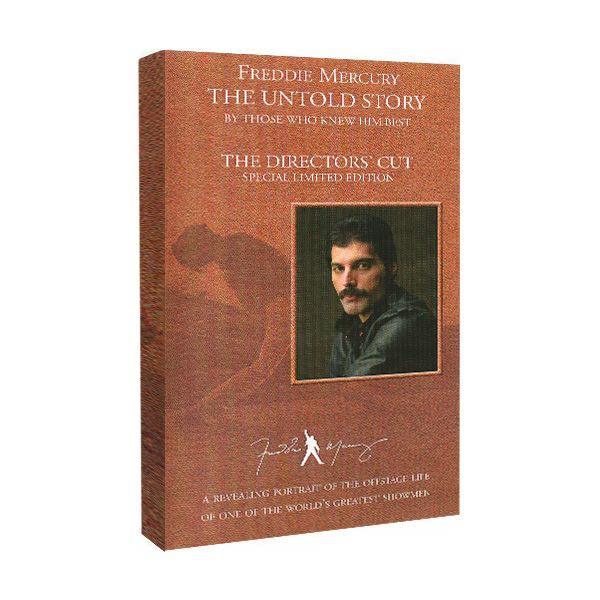
“Of course I couldn’t get Queen, so I thought, to hell with it, I’ll have Freddie Mercury. I liked him. He was very bouncy, very effusive – very drunk.” CBS boss Walter Yetnikoff on signing Freddie Mercury.
A documentary feature by the DoRo film-making team of Rudi Dolezal and Hannes Rossacher, The Untold Story is a journey across time and culture, tracking the life of the young Farrokh Bulsara from The Hospital Government Zanzibar where he was born on September 5, 1946, through his schooldays in India and the suburbs of 1960s Bohemian London, and over the two decades of extraordinary and fabulous success that followed.
There were those who shared an extremely close relationship with Freddie: his mother and father, Jer and Bomi Bulsara, and sister Kashmira; Mary Austin, his long time girlfriend; designer Diana Moseley, who first met him on his Born To Love You video and became designer of his private wardrobe and public costumes; Peter Freestone, his personal assistant for more than ten years; and Jim Hutton, his boyfriend at the time of his death. Outside of this close circle there were the friends, photographers, record producers, and record bosses; and back in Zanzibar and India, the relatives, school friends, even his first child sweetheart. Together, they weave the rich tapestry that was the life of Freddie, across this powerful programme.
Mary Austin, the person perhaps closest to Freddie throughout his life, talks lovingly and at length about the man who she was all but in name ‘married’ to: “It was a relief when he told me he was gay. How could I deny him the right to be at one with himself? It was a love that you accept and understand because you want the person inside to grow, and fascinating to see this person finally at ease and at one with himself; it was an almost euphoric feeling.”
Jer Bulsara and Kashmira tell how it was inevitable that Mercury would want to leave Zanzibar: “for a boy like him there wasn’t much for him to do, instead he was always looking at magazines which came from overseas and wanting to know what it would be like to be there.” Jer talks about Freddie’s first journey away
from the family — sent, just before his 9th birthday, to St. Peter’s, a residential boarding school in India, a period that was to have a dramatic influence on his development as a budding musician and performer.
It is in the section filmed at Freddie’s school that we get the first real insight into Freddie’ burgeoning talent as musician and performer. Freddie formed his first band, The Hectics, there. While Freddie and The Hectics may not have shaken the world outside India, the impression they made locally was seismic.
It was perhaps Freddie’s preoccupation with music that resulted in his leaving St. Peter’s having failed his academic exams, and a report which rounds up his achievements as: “accomplished boxer, good singer, outstanding pianist, unbeatable table tennis player, thoroughly mediocre cross country runner.”
Reflecting on the years in which Freddie reigned one of the world’s most fabulous rock stars, fashion designer Zandra Rhodes talks about the evolution of the Mercury image: “He was a free thinker; I think those changes of image show a wonderful free-spirit.”
Spanish Opera legend Montserrat Caballé recalls how nervous he was at their first meeting: “I felt the cold on his hand, I thought he’s nervous too, so that’s good, because when people are nervous it means both are expecting something from one another”. Montserrat also recalls the night spent around Freddie’s piano when they first got to know one another. “It was a very special night, a wonderful night I will never forget. It was such a wonderful time that we didn’t realise that time passed so quickly. It was 6 o’clock in the morning when I left and there were lots of people in the street, surprised that I had spent the night in Freddie’s home!”
Freddie’s final days are movingly told by his family, boyfriend Jim Hutton, assistant Peter Freestone, and Mary Austin, who says:
“Freddie had given himself a limit. I think personally that when he couldn’t record anymore, when he didn’t have the energy to do it, it would be the time, because his life had been his work and his joy, and without it he wouldn’t have been strong enough to face what he had to face.”