Books > FREDDIE MERCURY: A LIFE, IN HIS OWN WORDS
My privacy has always been very special to me and I am famous for my lack of interviews. Please understand this policy will continue." Freddie Mercury. Last public statement, made one day before his death, November 23, 1991.
Public property as the posturing, mercurial lead singer of Queen, with whom he shared twenty years and nearly 200 million record sales, there was, however, much about Freddie Mercury that remained known only to those within his closest circle.
Freddie’s final statement highlighted the way he chose to live – avoiding interviews and unnecessary dialogue with outsiders. The truth was that Freddie was painfully shy and uncomfortable in the company of anyone who might intrude upon his famous ‘royal family’ of close friends and invited guests.
Yet Freddie could still make headlines, and usually all it took was a single sentence.
Freddie’s one-liners were collected as avidly as the band’s musical rarities, and today command their own websites. Just browse these sites and you come to realise that while Freddie may appear to have said very little, he has probably become one of the most quotable rock stars of all time. Try finding, for instance, a site given over to Dylan or Jagger quotes. Maybe only Elton comes marginally close.
Perhaps Freddie’s verbal prowess in part stemmed from his love of Hollywood movies, and hours spent watching his favourite stars, such as in Billy Wilder’s Some Like It Hot, George Cuckor’s The Women, and Lana Turner in An Imitation of Life - films he would watch again and again - not to mention his love of Marlene Dietrich, Joan Crawford and Bette Davis; strong women who wielded their power in their verbal handbags.
“I enjoy being a bitch. I enjoy being surrounded by bitches. Boredom is the biggest disease in the world, darling.” Freddie’s words, but they so easily could have been exhaled from the mouths of any of his Hollywood idols.
Though Freddie talked rarely to others about himself, the interviews published - and some unpublished until now, compiled in this book - together provide an intriguing insight into a man who outwardly exuded confidence and arrogance, but behind that public perception spent periods alone and searching for happiness. As these pages turn we see a Freddie Mercury gradually changing the priorities in his life, to one more sedate, and necessarily changed by the cloud of the HIV/AIDS virus begining to shadow the gay community.
Freddie Mercury: A Life, in his own words takes us on the journey of Queen – three academics and a frustrated art student, tired of having no money, taking on the music industry on their own terms. Spurred on by an almost uncontrollable, ambitious and forthright Mercury, Queen succeeded, becoming the biggest band of the generations to come. The story, told in his own words, shows how on many occasions the band almost split, but was always kept together by their shared love of breaching musical boundaries. Freddie’s own personal story is one of pursuing a dream, dealing with wealth and fame, looking back and having no regrets, and coming to reflect on his thoughts on getting old, his legacy, and death.
“There are times when I wake up and I think, “My God! I wish I wasn’t Freddie Mercury.”
“I love the fact that I make people happy, in any form. Even if it’s just half an hour of their lives, if I can make them feel lucky or make them feel good, or bring a smile to a sour face, that to me is worthwhile.”
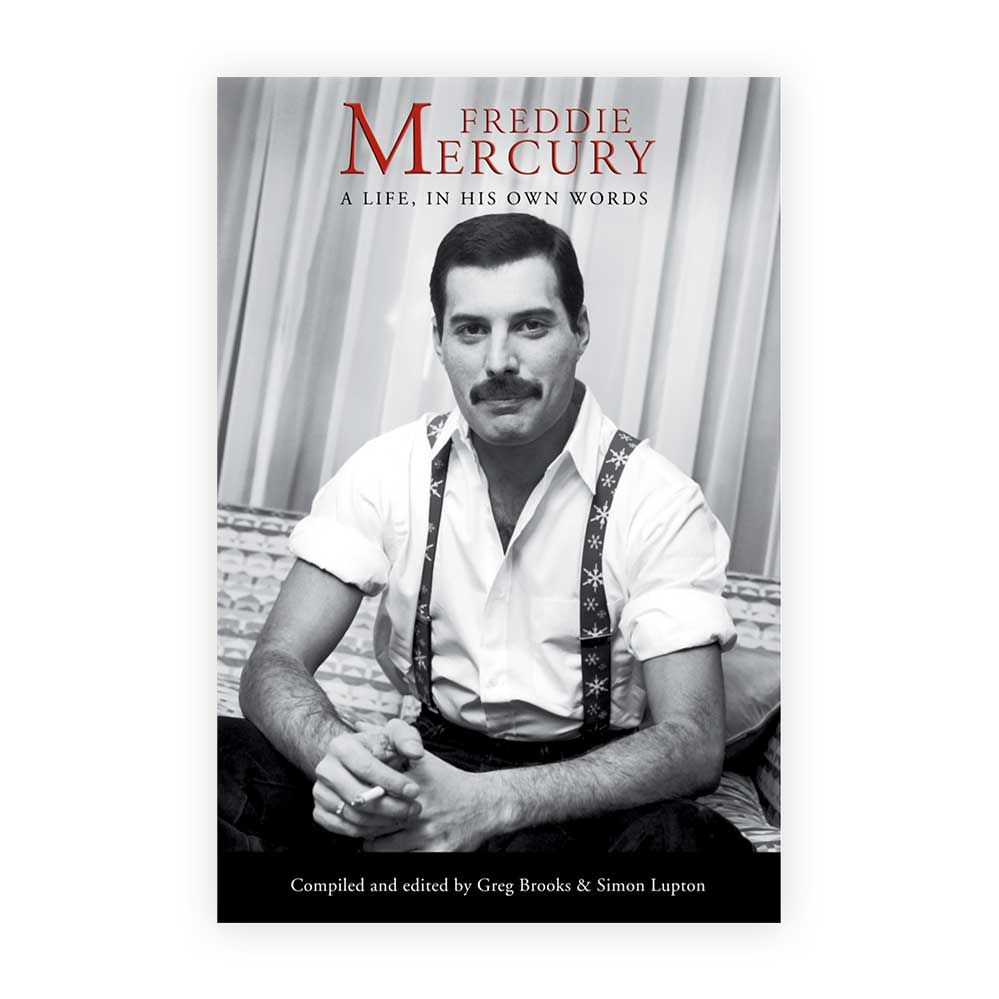
Freddie Mercury. A life, in his own words.
Compiled and edited by Greg Brooks and Simon Lupton